marketing@innominds.com






In the evolving landscape of enterprise automation, large language models (LLMs) are becoming pivotal in transforming traditional workflows. By utilizing AI agents based on LLMs, businesses can automate complex processes, reduce manual interventions, and enhance decision-making capabilities. These AI agents, which can understand and process natural language inputs, collaborate to perform a variety of tasks—from data processing to real-time decision-making.
What Are AI Agents?
AI agents are intelligent systems powered by large language models like OpenAI's GPT series or similar models (BERT, T5, LLaMa). These agents are designed to perform specific tasks by understanding and processing unstructured data, especially text, in natural language. They can:
- Understand business requests
- Classify tasks based on context
- Query data sources for relevant information
- Make decisions or suggest actions based on their findings
- Automate responses, workflows, and escalations
In essence, LLM AI agents extend beyond rule-based automation, using advanced semantic understanding and natural language processing to drive business processes.
Workflow Automation Architecture with LLM AI Agents
For a more in-depth look at how LLM AI agents operate within a workflow automation framework, let us break down a technical solution architecture for automating a business process using these agents.
1. Architecture Components
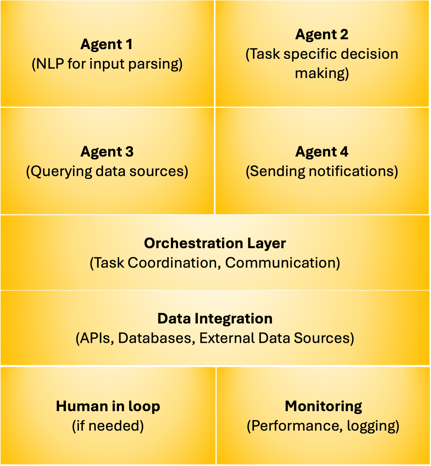
- AI Agents: Specialized agents that handle different tasks, such as understanding inquiries, making decisions, querying databases, and automating responses.
- Orchestration Layer: Responsible for coordinating task flow between various AI agents, ensuring seamless communication and task delegation.
- Data Sources: External systems, APIs, or databases that agents query to retrieve or update information.
- Human-in-the-Loop: A mechanism that allows human oversight when AI decisions require validation or intervention.
- Monitoring & Logging: Used for auditing and tracking the performance of agents, logging decisions, and providing insights for improvements.
Solution Architecture Diagram
Use Case: Automating Customer Service Ticket Management
Let us explore how an automated customer support system can be built using LLM AI agents, allowing a business to handle customer inquiries, classify issues, query data, and either resolve the problem or escalate it to a human agent.
NLP Agent for Input Parsing: This agent processes the inquiry, extracting important entities like issue type, urgency, customer details, and relevant context from the text.
Classification Agent: This agent classifies the issue (e.g., Billing, Shipping, Technical Support) and assigns a priority level based on urgency.
Data Querying Agent: This agent queries the order management or inventory system to check the status of the order.
Notification Agent: Based on the data received, this agent crafts a response or triggers escalation to human agents.
Agent Orchestration: Coordinating AI Agents for Workflow Automation
In a real-world automation scenario, LLM AI agents do not operate in isolation. They need to collaborate and coordinate efficiently. This is where agent orchestration comes into play.
Orchestration Layer
The orchestration layer plays a pivotal role in managing the interaction between various AI agents, ensuring that tasks are passed from one agent to another and that all agents work in concert to complete the workflow.
For instance:
- LLM Agent 1 handles customer inquiry parsing and passes the result to LLM Agent 2, which classifies the issue.
- LLM Agent 3 receives the classification and queries relevant systems for additional data.
- LLM Agent 4 then either resolves the issue or routes it to human support.
This orchestration ensures that the workflow runs smoothly, with each agent managing a specialized task while communicating with other agents.
Conclusion: The Future of Workflow Automation
LLM-based AI agents are revolutionizing the way businesses approach workflow automation. With their ability to understand and process natural language, these agents can collaborate to handle complex tasks, from customer service to supply chain management. By integrating these agents into a well-orchestrated architecture, businesses can create highly efficient, scalable systems that improve operational efficiency, reduce costs, and enhance customer satisfaction.
References:
- Langchain: https://python.langchain.com/docs/tutorials/agents/
- Autogen: https://www.microsoft.com/en-us/research/project/autogen/
- Huggingface: https://huggingface.co/models