marketing@innominds.com





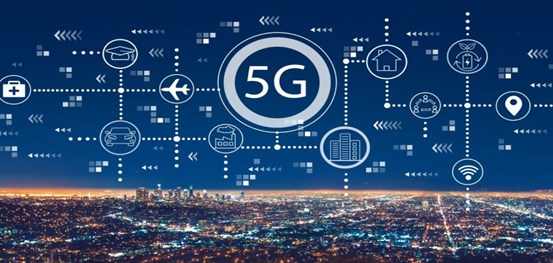
While next-gen innovations such as virtual reality, the Internet of Things (IoT), and AI-enabled automated cars are driving the next paradigm shift, 5G is all set to provide the exponential improvement in bandwidth and latency reduction to power these advancements.
Customer expectations continue to rise when it comes to the performance of wireless technology. Mobile users want faster data speed and more reliable services. The Fifth Gen Wireless technology brings speed (wider channels), more bandwidth, and higher responsiveness when compared to its predecessors. That means, we can download a high-definition movie in seconds without any lag. The connectivity benefits of 5G are expected to make enterprises more efficient and give consumers access to more information faster than ever before.
As per the world economic forum report, 5G will enable $12.3 trillion of worldwide economic output and support 22 million jobs worldwide by 2035. This is because the global network of computers and devices has changed our lives tremendously. Also, with the increase in the number of internet users (more than 63.2% of the world population uses the internet) and their demand for data, 5G must handle far more traffic at a much higher speed than today’s combined cellular network.
Fifth Generation technology promises a variety of services with improved latency and that leads to ultra-reliability. Companies are betting their futures on their ability to develop enticing, innovative, and sticky digital interfaces on time, without glitches in performance or functionality. On the road to support a successful transition, 5G test practices are being developed and refined to ensure the reliable and consistent 5G performance that end-users demand.
Emerging 5G Technologies and Challenges
- Millimeter-Wave: With the rapid increase of mobile traffic demands, the bottleneck between capacity requirements and spectrum constraints is becoming increasingly apparent. The choking point of wireless bandwidth becomes a major issue for 5G telecommunication.
Conversely, millimeter-wave with great bandwidth from 30 GHz to 300 GHz, compared to the bands below 6 GHz that were used for mobile devices in the past, are being proposed for multi-gigabit communication services.
In addition to the higher effect of noise power in millimeter-wave due to usage of larger bandwidths, there is higher path loss, reduced scattering, resulting in a reduction in channel diversity, and increased blockage from weaker non-line-of-sight paths. These are serious issues that must be overcome for efficient mobile communications in the millimeter-wave spectrum. - Massive MIMO: Multiple Input Multiple Output (MIMO) systems that are being used in wireless communication require a combination of antenna expansion and complex algorithms. It is common for both networks and mobile devices to have multiple antennas to enhance connectivity and offer better speeds and user experiences. MIMO comes into play to control how data maps into antennas and where to focus energy on space.
Massive MIMO, an extension of MIMO, expands beyond the legacy systems by adding a much higher number of antennas on the base station. The “massive” number of antennas brings drastic improvements in efficiency and throughput by helping in focusing energy.
However, installing many more antennas to handle cellular traffic might cause more interference in the signal.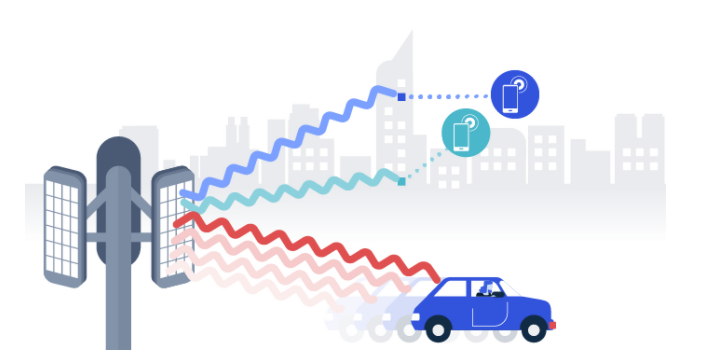
- Beamforming: Beamforming is a traffic-signaling system for cellular base stations that reduce interference for nearby signals in the process by identifying the most efficient data-delivery route to a particular user. There are several ways for 5G networks to implement beamforming, based upon the situation and the technology.
Signal-processing algorithms plot the best transmission route through the air to each user at massive MIMO base stations. Then they can send objects in a precise coordination pattern and individual data packets in many different directions, bouncing them off buildings. In short, massive MIMO is a massive 3D beamforming that increases horizontal and vertical coverage capabilities.
The combination of millimeter-wave utilization, MIMO, and beamforming provides the infrastructure of 5G and the passageway to incredible performance enrichments for our evolving digital world. The added complication introduced by these innovations can also pose challenges for 5G test networks as well as the overall 5G testing process.

With an early focus and investment in 5G technology, Innominds have developed a setup that delivers a 5G network including functional and automation services for global service providers. In our experience, a holistic quality engineering service must address an array of issues mentioned. Testing covers five dimensions:
- Usability testing addresses quantitative validations like error rates (compared to industry standards) and guidelines on such aspects as human-computer interaction—addressing navigation, presentation, content, and interaction.
- OTA test to ensure device performance and reliability in a repeatable, systematic way by placing the device in a chamber and testing its assets—including the antenna, the RF front end, and the baseband.
- Stability and conformance testing call for engineers to thoroughly test the protocol functionality, parametric performance, and physical-layer (PHY) characteristics of the device’s chipset using the same emulated network and communication channels employed by 5G carriers.
- Security testing and validation capabilities allow you to detect and mitigate vulnerabilities early and often by performing both point-in-time testing and continuous assessment of the 5G environment.
- Field testing: Testing new 5G devices in live networks requires the development of a new suite of test cases. The test suite provided is comprehensive, covering basic operations (attach and detach, mobility, data transfer in various deployment configurations), performance aspects including power consumption, and inter-working with legacy networks.
These powerful yet flexible test solutions tacitly support the greatest technology revolution of the 21st century. Once fully realized, 5G will bring a lot to the table and will be a driver of digital transformation across a wide range of industries, including within the telecom operators investing in 5G network and spectrum assets. And in the long run, 5G will not only pave the way for a new era of improved network connectivity but also new connected experiences for users across a diverse set of industries.