marketing@innominds.com






When you are connecting with a colleague over Google Docs, you are using the cloud. If you look at it, then from your Microsoft Onedrive to Evernote, everything is run by the cloud. These applications are a substantial part of our daily office routine, so ingrained in our structure that we don’t even realize what technology is driving it.
This means that at some level, all of us are already using the cloud. So, when we are talking about cloud migration, we are actually referring to a major shift to remote working, internet-based access, and agile infrastructure.
Let’s start by understanding the basics of the cloud:
What is cloud computing?
Cloud computing is a technology that provides on-demand computing resources, such as servers, networking, storage, software, etc. The reason why cloud computing is different from desktop computing is the way servers are designed. These servers are spread across multiple locations offering server redundancy for better uptime, availability, and accessibility.
Cloud computing and everything it has to offer have taken the computer world by storm in recent years. Due to internet-powered Cloud Migration and Automation, which is supporting various organizations across the world in making seamless changes, a company's computing demands have decreased. Cloud Engineering is vital in supporting organizations' Digital Transformation across all industrial verticals.
Why do you need to migrate to the cloud?
Did you know that cloud computing has become a go-to technology for small, medium, and large businesses ever since the pandemic? When COVID-19 first started, businesses faced challenges in planning the new work culture. As a result, in only two months, we observed a digital transformation that would have originally taken us two years.
According to recent research, the cloud computing market was worth $371 billion in 2020, and it is already expected to reach $832 billion in the next three years.
What is Cloud Assessment?
Isn’t it a good idea to identify the feasibility of cloud migration for your organization?
The process of achieving the same is cloud assessment. The key motive behind this assessment is to know cloud migration feasibility; whether you can migrate to the cloud or not. This assessment will allow your team to deeply understand the consequences and challenges of the migration process.
After the cloud assessment, it is common for organizations to conduct a gap analysis. This allows addressing the challenges found during the cloud assessment. Our goal is to identify the gaps in cloud migration and understand the process of mitigating challenges and filling gaps.
Steps to Assess your Cloud Readiness
Throughout these steps, we will assess your cloud readiness:
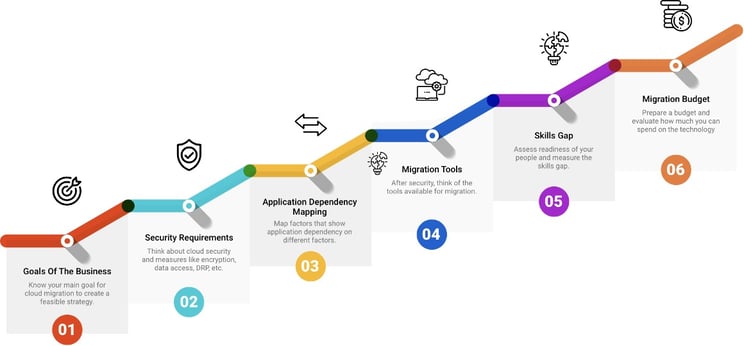
1. Business Goals and Objectives
Before we start planning our cloud migration, it is necessary to know the objectives and goals behind cloud adoption. It is likely that at this stage, you may not have a clear goal in mind. Therefore, here are some factors you can evaluate to know whether you need the cloud or not:
-
-
Do you want to optimize maintenance costs?
-
Do you need scalable IT architecture?
-
Are you trying to build a hybrid work culture?
-
Do you need to allow BYOD without worrying about security?
-
Are you looking for better uptime and architecture resilience?
-
These questions will help you put your objectives in perspective. For example, many startups and small businesses utilize the cloud to optimize maintenance costs and reduce IT hassle. Cloud hosting for business applications helps eliminate maintenance costs and IT admin tasks.
Similarly, you should know your main goal for cloud migration. It allows for creating a feasible strategy. Remember to have realistic, well-defined goals for data-driven decision-making.
2. Security Requirements of your Business
With the increasing number of cyberattacks, you should think about business security during cloud migration. This is not an option, but a necessary step. This is exactly why we believe your organization must contemplate and assess cloud migration on cloud security.
Your service provider or the B2B business helping you with migration should be able to offer these security measures (or your team should be able to implement these):
-
-
Internal and external firewalls; access control and multi-factor authentication
-
Data encryption; in transmission and at rest
-
Disaster recovery; including business continuity and backup
-
Intrusion Detection and Prevention
-
Physical server security
-
Another thing that we should be talking about is compliance.
If you are in healthcare, wouldn’t you need HIPAA compliance on the cloud?
If you are nodding, then you need to consider compliance rules and regulations to ensure smooth, secure, and penalty-free functioning on the cloud.
Along with this, ensuring CloudSecOps is a crucial concept in cloud security. SecOps is the collaboration between the security and IT operations team, which helps manage a highly advanced security environment. The SecOps team of the business monitors risks, secures corporate assets, and manages complete security operations. When migrating to the cloud, SecOps professionals may require necessary upskilling. The cloud is a dynamically changing environment, and building a CloudSecOps team with relevant skills, like Azure and AWS, may improve security operations.
Every application depends on a range of factors, and application dependency is a concept that helps us identify these factors. We map apps in a way to know the underlying infrastructure, type of resources, legacy data storage systems, and server dependency.
This knowledge helps in three ways:
-
-
You can know the priority of each application category
-
You can know data that you can’t migrate to the cloud
-
You can categorize application migration based on the level of difficulty in migration
-
After security, think of the tools available for migration. You can also connect with a cloud provider to receive this service, which will be a hassle-free option.
5. Skills Gap or Team Potential
Is your team capable of adopting the cloud and making this change?
We often believe that the biggest bottleneck for technology adoption is the migration challenge. In reality, the true roadblock in cloud migration or any technology adoption is the readiness of your people. If your employees are not capable of adjusting to the change, you may never achieve complete efficiency.
Ask yourself:
-
-
Is your team capable of handling this transition?
-
Do you need to train people?
-
Have you ever handled change management before in the company?
-
What type of tools and technologies may help you with this?
-
The reason why you should be asking these questions is to know the skills gap in the workplace.
For example, your IT team has no clue how cloud migration works in the real world. Of course, these professionals understand the concept, but they have never actually achieved it. In this case, you can set up a training program to help IT admins learn end-to-end deployment. You need strategic partners for the company during this transition, and upskilling is the method for achieving this.
Most businesses don’t have a budget in mind when they are moving towards technology migration.
Would you visit the appliances store without knowing the budget for buying that new toaster? Absolutely, not! So, why would you do it in the case of the cloud?
Whenever you are (as a business) adopting new technology, always prepare a budget. There should be a bar on how much you can spend on technology. Once you know that, you can move forward and find the Total Cost of Ownership.
For example, in cloud computing migration, you can use the following factors:
-
- Endpoint costing
- Productivity increase
- Resource optimization
- Maintenance costs
- Security costs
These factors will help you estimate the TCO, which will allow your business to stick to a budget at the time of cloud migration.
Benefits of Cloud Assessment
-
A detailed view of cloud value via cost-benefit analysis
-
A comprehensive understanding of how the cloud benefits different business applications
-
A benchmark for industry practices accompanied by a detailed roadmap for migration
-
A method to ensure maximum value is extracted from this investment
-
An elaborated view of future challenges and methods to resolve bottlenecks
Components for Cloud Adoption, Assessment, Migration, and Modernization from Innominds
Innominds uses a complete and adaptable cloud adoption and migration methodology that includes applications, analytics, infrastructure evaluation, and cloud testing to provide businesses the advantage they need to protect, modernize, automate, and decrease costs. Adopting a cloud-first strategy for new systems maximizes the cloud's entire value. The standardization and automation of the IT environment through an open API paradigm, as well as exploiting new capabilities to deliver creative business solutions, make this change conceivable and feasible.
Innominds gives four important components to a business under the strategy:
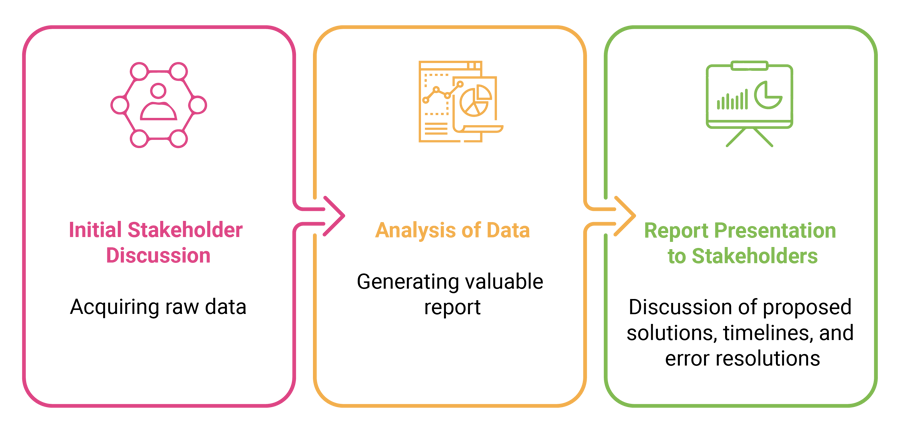
- Assessment: Innominds uses several cloud assessment tools to examine the performance and capabilities of various cloud services in order to identify corporate applications that can be migrated to the cloud. As a result, it improves efficiency, which speeds up an organization's cloud adoption path.
-
Architecture & Design: Our architecture blueprint and implementation roadmap for managing large amounts of data, multi-tenancy (if needed), and general scalability go a long way in an organization's cloud migration and modernization journey.
-
Migrate: Innominds helps businesses migrate their applications to the cloud using one of three approaches: Rehost, Refactor, or Re-engineer.
-
CloudOps: Innominds helps establish CI/CD and automate application development and configuration management, as well as infrastructure deployment and consolidation. Apart from resource consumption and service operational health, we also aid in monitoring cloud service usage and performance. Innominds provides auto-provisioning and de-provisioning of servers as needed.
Conclusion
When you are migrating to the cloud, you need a definite reason for this transition. It is a technology migration involving several stages of change management. Your IT department may need to handle the extra load during the transition and your employees may need to take training for the new technology.
Therefore, keeping important factors in mind, assess your cloud readiness. Know the way the cloud will impact your operational efficiency and business productivity.
A cloud readiness assessment may turn a company's hazy concept of shifting to the cloud into a precise strategy that describes how to do it and in what sequence things should happen.
Get a Cloud Assessment Today!